NASA Programs
Project Mercury
America’s first human spaceflight program: one astronaut, one capsule, six crewed flights.
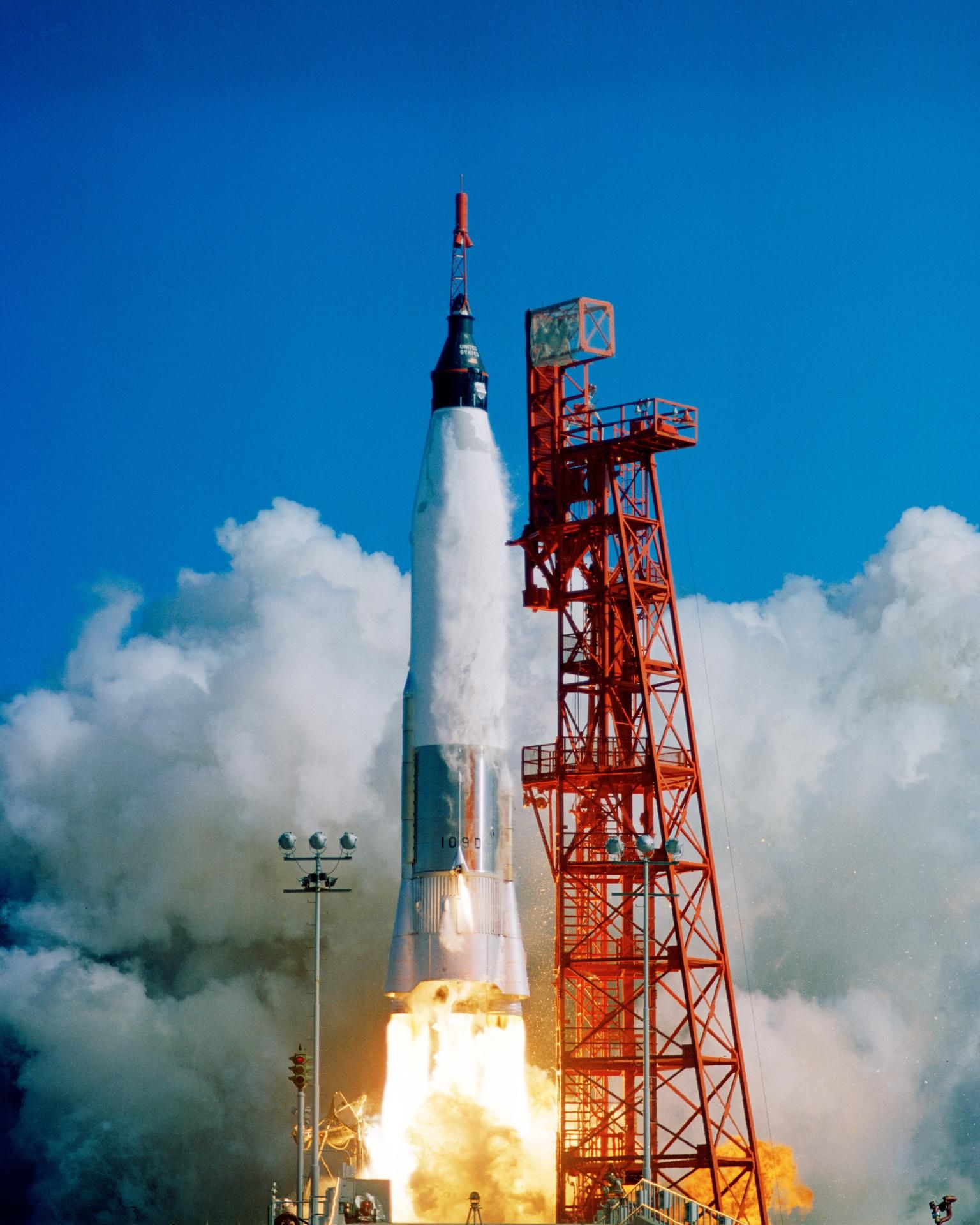
Project Mercury was NASA’s opening chapter in crewed spaceflight. The goal was straightforward and enormous: put an American into space, orbit the Earth, and bring him home safely. The spacecraft was a one-person capsule barely large enough for its pilot; the launch vehicles were the Redstone for suborbital flights and the Atlas for orbital ones.
Seven military test pilots—the Mercury Seven—were selected in 1959 and became national figures almost overnight. Alan Shepard flew the first American spaceflight on Freedom 7 in May 1961. John Glenn became the first American to orbit Earth aboard Friendship 7 in February 1962. Gordon Cooper closed the program with Faith 7 in May 1963, spending more than a day in orbit.
Mercury proved that a person could survive launch, work briefly in weightlessness, and return through the atmosphere. It also exposed every limit of a single-seat capsule: no docking, almost no maneuvering, and no room for a second crewmember. Those lessons shaped Gemini and Apollo.
Milestones
- 1961-05-05Freedom 7 — Alan Shepard flies a 15-minute suborbital arc on a Mercury-Redstone—the first American in space.
- 1962-02-20Friendship 7 — John Glenn completes three orbits on a Mercury-Atlas, the first American orbital flight.
- 1963-05-15Faith 7 — Gordon Cooper flies the final Mercury mission, more than 34 hours and 22 orbits.
Summary original to flyARIA.com. Photograph: NASA. NASA images are generally not protected by copyright in the United States; credit does not imply endorsement.